81
2 INGOTS OF LEAD FROM GREENHOW –
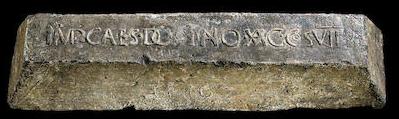
In February 1734, Mr Henry Smart Stevens sent a drawing of two ingots of lead to the Royal Society. They had been found, buried two feet deep, on the side of a track at Heyshaw Bank near Dacre in 1731. A countryman’s horse slipped when its foot fell into a hole covered with heather. The curious rider thrust his hand into the hole and pulled out the two large pigs of lead.
Each ingot was 23¼ inches long by 5¾ inches wide, but one weighed 156 lbs and the other 155 lbs. Both were wedge-shaped and were inscribed Imp. Caes. Domitiano. Aug. Cos. VII [Imperatore Caesare Domitiano Augusto Consule Septimum], which means that they were cast in Emperor Domitian’s seventh term as Consul, or circa 81 A.D. The word BRIG also occurred on the reverse side.
Upon analysis, these pigs contained 2 oz. 3.2 dwts per ton of silver, with a trace of gold and small amounts of copper and antimony.
The pigs became the property of Sir Thomas Ingleby, the landowner and were stored at Ripley Castle. One pig was bequeathed by Sir John Ingilby Bt. to the British Museum in 1772, (Accession no. 1772.9-11.1). The other was finally sold at auction in 2007 for £36,000 by the Craven Museum at Skipton. It was purchased with support from the Arts Council England/V&A Purchase Grant Fund, The Headley Trust, the NYCC County Councillor Locality Budgets scheme, Craven District Council’s museum acquisition budget, and a private donation.
Another ingot was said to have been found at Nussey Knott, near Stump Cross dated from AD 98.